 MERTON HISTORICAL SOCIETY
 Journeys Round a Lonesome Childhood
by Tony Shelton
‘I was born during World War Two, in 1942, so my childhood memories are of the 1940s and 1950s. Many are of the journeys on foot, by bicycle and by bus. As my sister was so much older than me I was brought up as an only child and I recently learned that the area where we lived was once known, fittingly, as Lonesome. It seemed to be a kind of no-man’s-land only 200 metres or so within the boundary where Mitcham, Surrey, met Streatham, London.
‘For the first eighteen years of my life, I lived in Windermere Road, off Rowan Road. I left it all behind in 1960 when I went to Manchester University. Some forty years ago, I returned for a visit and found the area to be very different from the place in my head: the roads were now lined with cars, the small front gardens had become parking spaces and, above all, everything was smaller and narrower and shorter than I remembered; I was, of course, somewhat taller than in my early years.’
So begins Tony Shelton’s delightful reminiscences of his ‘Lonesome Childhood’. Sadly Tony died shortly before this booklet was ready to print, but we are grateful to his daughter for allowing its publication.
Tony SheltonMERTON hiSTORicAL SOciETY 2026
1
Map of the area drawn by the author
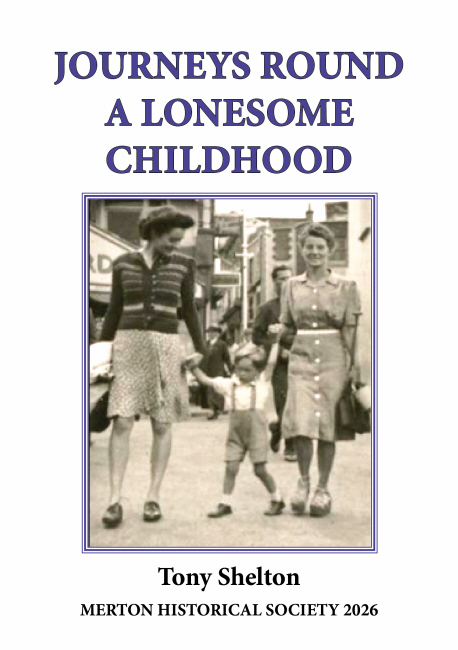
Cover photo: The author in 1945 with his mother and sister
2
Journeys Round a Lonesome childhood
I was born during World War Two, in 1942, so my childhood memories
are of the 1940s and 1950s. Many are of the journeys on foot, by bicycle
and by bus. As my sister was so much older than me I was brought up as
an only child and I recently learned that the area where we lived was once
known, fittingly, as Lonesome. It seemed to be a kind of no-man’s-land
only 200 metres or so within the boundary where Mitcham, Surrey, met
Streatham, London.
For the first eighteen years of my life, I lived in Windermere Road, off
Rowan Road. I left it all behind in 1960 when I went to Manchester
University. Some forty years ago, I returned for a visit and found the area
to be very different from the place in my head: the roads were now lined
with cars, the small front gardens had become parking spaces and, above
all, everything was smaller and narrower and shorter than I remembered;
I was, of course, somewhat taller than in my early years.
When Things were Larger
Seventy years on, all might seem as it was.
No streets, just roads and lanes, and ways and avenues with
laurel hedges, low brick walls, castellated for show,
and cream-rendered houses, all the same,
all with puddled cinder alleys at the back
overhung by apple trees in scrumping reach.
This was the theatre of childhood moments, the stage
on which we played and wondered, sulked and wasted time,
But now that world is small and far away.
Now, towering dun-tiled roofs can be conquered with a ladder,
Thames-wide roads crossed in a stride or two
and blue horizons are merely staging posts.
That world is cleansed of scents of piggeries, tar and smoke
and seedy summer grass. And lost are the sounds, of horses, steam
and approaching bands of bugles, flutes and drums.
That small unclouded world of unaware, where things were large,
is a lost world now whose faded charts are out of date.
Like most people, I suppose, I still carry around a mental map of my home
territory and of the routes within its boundaries and to places in other
parts of London and beyond. Attached to each journey are memories of
3
people, places, incidents, discoveries, and feelings. Often, one memory
will trigger another. Everything seems inter-connected in some way,
just as the South London suburbs merge with one another to make one
amorphous mass with no obvious borders.
I have since learned more about my boyhood territory from the rich material
in the newsletters and publications of the Merton Historical Society which,
here and there, I have drawn on to provide some factual context.
Our house
We lived in a mass-produced 1920s terraced, pebble-dashed house, similar
to hundreds of others in the surrounding roads and avenues. My parents
rented the house from a mean landlord who was reluctant to make repairs
but keen to collect the rent; I think I remember hiding once when he
called to collect a month’s rent. There was no telephone: we used a call box
round the corner by the shops on Rowan Road.
The Garden had loganberries along one of the side fences, a lawn with
room for a prop and clothesline and a plot with gooseberries and runner
beans. At the bottom, stood a rotting blue shed with, next to it, a potato
patch. Behind, through the tall wire fence, was the Smith Meters factory
(making parts for fighter planes in war and petrol pumps and electricity
meters in peace). I used to hang a straw target on the shed for archery
practice with my bow and steel-tipped arrows. I often missed the target,
put the shed windows out or sent arrows hurtling through the fence and
into the factory access road. It was lucky that I avoided killing or maiming
anyone. Why was I given such a deadly birthday present? What were my
parents thinking of?
Near the house stood the white-brick air raid shelter with its thick concrete
roof. When, during the latter years of the war, the hideous wailing sirens
sounded, I would get out of bed, and toddle down to the air raid shelter
and put on my Mickey Mouse gas mask which blew a raspberry when I
breathed hard through its floppy rubber nose. There we stayed on our
bunks until the all-clear sounded. Is this my own memory or is it what I
was told later? Maybe a mixture, for I am sure I remember the grumbling
noise of the doodlebugs as they passed over, meaning we were safe. And
the sound of sirens still makes me shudder. These early incidents lie at the
boundary between personal memory and received memory.
4
After the war, my father demolished the shelter, with a tiny bit of help
from me, and made an ‘Italian Garden’ with the bricks. There was one
other wartime legacy: a stepladder. Thanks to a few bombs aimed at the
Smith Meters factory, the house suffered a number of ceiling cracks. Soon
after 1945 a builder came to repair them, paid for by what I assume was
a government war damage programme. They botched up the repairs (my
father moaned about the quality of work for a long time after) but they
left their old wooden steps behind. These served us for many years until
they fell apart.
Garden of 10 Windermere Road and Smith Meters c.1952
5
Windermere Road
The (then) concrete slabs of Windermere Road were the scene of two of
my very first memories though, again, some parts of them may have been
‘fed’ to me later. In 1945 the ending of the war was celebrated in two street
parties just outside our home, one for VE Day, the other for VJ Day. For
the victory in Europe, a stage was erected on the back of a lorry and, at
the age of just 3, I am told that I was persuaded to climb up and sing
‘Twinkle, Twinkle, Little Star’ for the crowd below. This took place very
close to my birthday and my mother laughed when, years later, she told
me that I thought that the whole event was my birthday party and that
the following year I was upset when there was no party for me. A couple
of months later, with the complete end of hostilities with the surrender of
Japan, there was a huge (to me) bonfire in the street. I do clearly remember
being allowed out in my dressing gown to sit on my three-legged stool to
watch the flames. The next day I could see that the fire had made large
cracks in the road, damage which lasted until a few years later when the
road was given a tarmac surface. I think these were the only community
events ever to take place in Windermere Road. I remember nothing to
mark the Coronation.
Neighbours
When the 1951 census is published, it will show a variety of occupations
and circumstances in the homes around us at the bottom of the road. The
neighbours I knew anything about varied with age, circumstances and
employment. Most were skilled workers or office workers: what might be
classified, broadly, as ‘lower middle class’, though, when I once asked my
father what class we were, he answered without hesitation: ‘Working class’.
I doubt if all the neighbours would have agreed with him.
During the war both my parents worked for the Ministry of Supply.
After 1945, they had a succession of jobs. My father was variously a
draughtsman, a salesman for office furniture firms Remington Rand and
Shannon Systems, a TV installer for Radio Rentals and DER and finally
a technical draughtsman for Morgan Crucible in central London. Soon
after I first went to school, my mother started working again, as a factory
production worker, first at Marco’s refrigerators and Smith Meters, both
close by in Rowan Road, then at Pascall’s sweet factory in Streatham
Road, Mitcham. Her last job was with the cake decoration manufacturers
6
J F Renshaw Ltd in Locks Lane, where she stayed until retirement. As far
as I remember, she cycled to the last two workplaces.
Next door was an RAF engineer, his wife from Cyprus and their little
girl. On the other side lived married pensioners and their two grown up
children still at home; the daughter worked in the offices of the Decca
record company. Five doors up lived a butcher and across the road, a
messenger for a stockbroking firm in the City of London and a fireman, a
large man and very impressive in his black uniform with its shiny buttons.
Garden of 10 Windermere Road and Smith Meters c.1952
7
My mother described him as a ‘gentle giant’. The older neighbours may
well have moved here as young couples in the 1920s and 1930s when the
houses were new.
At the top of the road on the corner, was the surgery of Dr Dutt, the first
Indian doctor anybody had seen. When I was about four, my mother was
making a cake and I stood on a little stool so I could reach and ‘help’ her
with the mixing. The stool tipped over and I banged my chin on the table
edge. I started to bleed. Straightaway my mother picked me up and ran
up the road to the surgery where the kind and gentle doctor gave me my
first (and only) stitches (I still have the tiny scar). I often wonder how
she found the strength to carry me all that way. Today, of course, no GP
would touch such a case – it would have to be dealt with at the accident
and emergency department of the nearest hospital. But this little drama
took place just before the founding of the NHS in 1948. I now wonder if
my parents had to pay the doctor.
The road brought the outside world to our door. The Liverpool Victoria
Insurance man called weekly to collect a penny for the policy which my
mother had taken out for me; I collected the tiny amount, made smaller
by inflation, when I was eighteen. Gypsies, camped on Mitcham Common
so it was said, occasionally called to sell pegs and lucky heather, though
with little success. The coalman, smeared black as his load, carried his
sacks through the house to a bunker in the back garden. There was also
the milkman and the breadman who called on Saturdays for their money
(and, in December, for their Christmas box) and the paper boy. The rag
and bone man, with his ‘Steptoe and Son’ horse and cart, used to ring his
bell to collect metal and rags in exchange for small change or a goldfish
in a plastic bag, or nothing at all. During the early post war years, the
‘salvage’ lorry would come to pick up our old newspapers (we now call
it recycling). It all seemed to work like clockwork, always that way and
forever. On Sundays, the tedium was lifted by the distant and exciting
sound of the drums and bugles of the Scouts or Boys Brigade on their
way to church parade. They would become louder and nearer until they
passed outside the house. I would rush to the window to watch. I tried
out both organisations by attending a meeting of each. The cub scouts just
baffled me and, when I went with a friend to the Brigade, I didn’t like the
uniform and couldn’t see the point of it all. I was a non-joiner by nature
8
Garden of 10 Windermere Road c.1952
9
and always disliked anything involving military uniforms. Later at the
grammar school, I also avoided the CCF (Combined Cadet Force). That
certainly didn’t appeal, not least because of the thick heavy and scratchy
uniform. Some of us ‘civilians’ used to snigger as we watched the cadets
when they paraded like toy soldiers up and down the playground.
Out in the road we played football, stopping only now and then to let a car
pass, and, in the summer, cricket with a rubber ball. On the pavement we
swapped ‘fag cards’ of cricketers, footballers and planes; we played ChingChang-
Cholla and dabs.
Ching-Chang-Cholla, as I later learned, seems to have been a London
name for what is generally known as Scissors, Paper and Stone. Dabs
is an old traditional game also known as Jackstones, Dibs, Fivestones,
Alleygobs, Otadama, Tally and Knucklebones. It is played the world over.
The dabs themselves are five small wooden cubes. You can still buy them
in their 1950s design. Not everything we did had a quaint local name
though. The northern ‘chumping’ was nothing more interesting than
‘collecting wood for the bonfire’. And ‘Knock Down Ginger’ was simply
‘knocking at the door and running away’ though we only did that in other
people’s roads.
In Autumn, everyone played conkers. We would find a chestnut tree and,
if there weren’t any conkers on the ground, we threw sticks up to knock
them off, bringing down more leaves than conkers. Everyone had conkers.
If you soaked them in vinegar, it made them tough but it was regarded as
cheating.
Round the corners, on Rowan Road
Round to the right, on the corner, lurked the greengrocer, with his heavy
limp, leather apron and large, lethal swede-cutting knife. He was a man
and a shop to avoid unless you were in need of an orange box to make into
a cart. The fish and chip shop next door sold gristly fish in thick, solid,
tasteless batter; I was always sure that fish and chips could be nicer (I was
later to find that I was right). But the fishmonger also sold fresh fish and
cod pieces for the cat. The third shop in the row was a grocer’s. This was
long before self-service and, of course, customers had to queue patiently
and then ask for every item to be taken from the shelves and, if needed,
weighed and wrapped.
10
Further down Rowan Road on the other side was the ‘bomb site’ where
we played cowboys and soldiers in old walls and piles of bricks and purple
and yellow weeds, The ‘bomb site’ was, so I have since found out, the
ruin of the Victorian Lonesome chemical factory (next to what was once
Lonesome Farm). Decades before, the works used to send its foul smoke
across the neighbourhood. The ground and remaining walls must have
been polluted, and it can hardly have been an ideal place for children to
play in. It suited nettles, rosebay willowherb and ragwort though. Next to
the bomb site, and opposite Marco’s refrigerator factory, Mrs White’s shop
was a honeypot for local kids. She sold sherbet dips and penny drinks of
coloured water and (illegally) Woodbines for a penny each. A notice told
customers not to ask for credit ‘because a refusal may offend’.
Turn left into Rowan Road and there was a newsagent’s and sweet shop, the
home of my Dandy, Beano and Eagle. There it was that chocolate returned
after the war, with the first Crunchies, Mars Bars, Cadbury’s Milk, Fry’s
and Maltesers. I used to hover, fazed by such choice. Soon I would need
teeth extracted. Next was a shop which fed my early teenage needs. It sold
electrical goods (my Dansette record player), records (including Elvis
Presley’s bombshell Jailhouse Rock) and, I believe, bicycles (my Philips
Kingfisher). Next door stood the butcher. This was Mother’s domain for
chops, sausages, braising steak, liver, rabbit and Sunday roast. I loved
meat as much as Mars bars.
Further on from the shops, stood Smith Meters, the big petrol pump
and meter factory, where my mother took her first part time job, and,
across the road, the ‘other shops’. The chemist, old Mr Panchen, bent
over, balding and pink-faced, stood in his white coat with shelves of
bottles behind him. He hardly ever spoke. The rather frightening barber
next door had a club foot that clumped as he edged round your chair. He
didn’t speak much either and unless you asked for a short back and sides,
he left you looking like a Bash Street Kid in the Beano, with a pudding
basin cut.
Almost next door, across Meopham Road, a side turning, was the entrance
to the crematorium, with its grand gates, its lodge and office and the
sinister building with the chimney. Beyond were the memorial grounds
and then more and more green as far as the eye can see. I didn’t know
where it went. I didn’t know how all the places joined up. I went into that
11
building and saw the full extent of the grounds when my father, who died
in 1958, was cremated there.
If you turned right after the ‘other’ shops you were in Meopham Road. We
used to walk down to the old piggeries, then run past holding our breath
to keep out the unbelievably foul smell.
Opposite Meopham Road, in Longthornton Road, my father once picked
up a piece of shrapnel from a landmine which had just exploded by the
nearby Smith Meters factory. He wanted it as a souvenir. But it was still
hot and burned his hand painfully. It was his only injury in either world
war: he was too young for the first and too old for the second. He was a
voluntary fire watcher, though. The road itself was like Windermere Road
– long and straight and lined with terraces, built in the 1930s. Recently,
I learned that, long before then, a speculative development of large villas
was started there but abandoned when the smoke from the Lonesome
chemical works deterred wealthy prospective buyers.
If you continued on Rowan Road for a few more yards you came to the
path which leads to St Olave’s church, built in brick (it was consecrated in
1930 and completed in 1931) and, to me, nothing but large and ugly. My
parents didn’t go to this or any church because my father couldn’t smoke
but I was christened at St Olave’s in 1943 and, at my sister’s wedding there
in 1945, I was told that I was made to act as a page. I had to hold her train
but managed to get my fingers tangled up in it and had to be freed by my
mother when the couple stood together ready for the ceremony. I still
have the wedding photograph with the bride and bridegroom and all the
relations from the two older generations spread out in front of what looks
more like Battersea power station than a church.
The only other times I went anywhere near the church was to play on the
adjacent recreation ground (‘The Rec’) which you reached from Rowan
Road along a short, narrow path. It wasn’t very exciting though – only
a patch of grass with bushes round the edge. There was a park keeper in
a uniform and peaked cap and pointed litter stick, like the ‘parky’ in the
Beano. I think ball games might have been banned and there was nothing
else to do there (probably the reason why it always seemed deserted).
Sometimes we played hide and seek in the shrubs. But we always kept a
look out for the parky. Once he chased us out waving his stick and we ran
down the path to the road where he couldn’t touch us.
12
Me as page boy at my sister’s wedding at St Olave’s, 1945 Me as page boy at my sister’s wedding at St Olave’s, 1945
13
Up the Road
It seemed miles to walk up to the top of Windermere Road and, when
you got there, it was a strange other world of posher houses with garages
and, behind them, private sports grounds. Stanford Road even had a little
hill, which, though not much more than a kink, seemed like a mountain.
I made a boxcart with an orange box from the greengrocer and my old
pram wheels. My friend and I pulled it for half a mile to find this hill and
raced down again and again.
I find it hard to fit all these places together, where they meet, the way they
seem to creep round and meet on the other side. Sometimes I used to
think that it would have been nicer to live in a village or small town where
there are fields and hills before you come to another place.
Stanford Road was the walking way to Saturday Morning Pictures at the
Rex on London Road, Norbury. At an early age I was allowed to go on my
own with a friend. When we arrived, we would have to stand in a queue
to be let in, a few at a time. There were always hundreds there to watch
the cartoons – Tom and Jerry, Mickey Mouse and Goofy – and the serials
– Flash Gordon, Hopalong Cassidy and Roy Rogers – and the comedies
– Laurel and Hardy, Abbott and Costello and the Three Stooges. There
was a constant din of screaming and shouting. If you sat downstairs in the
stalls, those up in the balcony threw things down at you – sweet papers,
rubbers, bits of litter, anything they could find. I don’t think parents had
any idea of what it was like. There was, though, the treat of ice cream and
ice lollies at the interval from a woman with a tray round her neck and lit
up by a spotlight.
The nearest hill to home was Pollards Hill and what is known as Pollards
Hill Park. It is closer to Norbury than Mitcham but it is the highest point
in the area and can give views as far as Windsor Castle, according to
Wikipedia. It was also the site of two epic childhood battles. The first was
a mass snowball fight. I was still in short trousers then and had to borrow
a pair of my mother’s red slacks. The second ‘battle’ featured lumps of turf
and barricades. Somehow, we got to hear in advance about these battles,
how I will never know; today we would blame smart phones and the
social media but then the news seemed to spread almost telepathically.
We had no idea who we were supposed to take sides against but there
were certainly two sides. I remember we walked from Windermere Road
14
and along the suburban roads into an unfamiliar part of Norbury to the
round grassy hilltop. I don’t think either side won but we returned wet
and muddy, with satisfaction at having taken part.
On the Bus
On the 118 – Northwards
The London Transport 118 route was the only one I knew. It connected me
to both ends of my world. For many years, the buses had pictures of eyes
on either side of the destination blind with the slogan ‘The Eyes Have It’.
It made no sense to me at all; it was one of those baffling grown-up things
which hinted at a world elsewhere, like a joke you didn’t understand. I
would catch the bus on Rowan Road and could have gone all the way to
Clapham, though I never did, only to Streatham. Just past Mrs White’s
shop, the bus turned sharp left into Greyhound Terrace, with its row of
tall, Victorian terrace houses. I thought they were slums because they
were old and grey (I changed my mind when I first saw the slums of
Manchester). Outside the end house, an elderly woman used to sit in her
tiny front garden. She had swollen feet. I looked at her from the bus and
felt uncomfortable and a bit sorry for her. Was that what it was like to be
old? She was always there, until one day she wasn’t.
Years later, when working in Leeds, I got into conversation with a
colleague, about my age, who lived very near Greyhound Terrace. We
found that we remembered the same places: Mrs White’s shop, the ‘bomb
site’, the refrigerator factory, the station and all the roads around. But
we lived separate lives and never met, due to the drawing of the County
boundary along Greyhound Terrace. He lived in the London County
Council area, I came from the Surrey County Council side. We went
to different schools, shopped in different places and lived separate lives.
Our circles might have overlapped a little, but we never met, never knew
of each other’s existence.
If you turned left at the end of the Terrace you were in Lilian Road. Here
were small terrace houses and, behind, two rows of lock-up garages
where my father kept the old car (always an old car). One or two of the
garages opposite ours were full of imported fridges; it was a cheap place
to keep them, I suppose, before they went into homes or shops. I always
wonder if using the lock-ups (in fact, the whole operation) was legal.
15
If you turned right from the Terrace you were in Streatham Vale. Halfway
up to Streatham Common Station, you would cross, almost without
knowing, a little bridge over a foot-wide trickle of water in a concrete
channel, hidden behind houses. This was the grandly named River
Graveney, tamed into subservience before it continued on its way to the
Wandle and so to the Thames. It was such a disappointment; I would have
loved a proper river to explore, or even a babbling brook. For some reason
I never discovered the more famous River Wandle, one of my regrets, now
I know of its historical importance.
Nearby, two family wartime incidents took place, according to my mother.
In the first, my father was coming home from work in the Ministry of
Supply in London (my mother also worked there for a time) and was
walking from Streatham Common Station when a landmine landed and
exploded nearby. The blast propelled him into the air and across the road
where he landed in a privet hedge and walked away unhurt. Then, roughly
in the same place, my mother was wheeling me in the pram when she saw
another landmine floating down close by. She picked me out of the pram,
dived into a convenient back alley and jumped on top of me, just as the
mine exploded. We were both unscathed and she may well have saved
my life so I owe her quite a lot, not least my continued existence. Later in
that same back alley, a friend and I used to go scrumping for crab apples,
jumping to grab the low-lying fruit from trees in adjacent gardens. I don’t
know why, because the little green apples were inedible.
Riding the 118 Bus – Southwards
The bus stop round the corner outside Smith Meters was a request stop.
That is where I stood and stuck out my hand to catch the bus to school.
My impression is that, even when in the Infants, I used to travel this way
on my own. That seems incredible now when parents drive their children
to school or supervise walking crocodiles.
The bus went along Rowan Road past the (Rowan Road) secondary
modern school where you went if you didn’t pass the 11 plus. Grammar
school boys, walking past in uniform, ran the gauntlet of being jeered
and attacked with stones hurled over the fence. Some forty years later I
found that a colleague of about my age, also came from Mitcham but had
failed the 11-plus and went to the secondary modern. However, he had
since gained the same professional qualification as me and had risen to a
16
more senior management position. A telling comment about the fairness
of selection at eleven.
My usual bus route to primary school took me as far as halfway down
Manor Road from where I walked a short distance down roads with
names chosen for their association with Robin Hood, past smart houses
with black and white half-timbered fronts, to Pollards Hill Infants and
later, Junior school (since demolished and replaced by Sherwood Park
School). The large two-storey brick building was very different to today’s
neat single storey primary schools. At the age of five on the first day, it
seemed to be a huge building (page 18) and the steps up to the Infants
school (page 19) towered above me. It stood by a large playing field with,
at the side, air raid shelters like ancient burial mounds. We did a lot of
country dancing on that playing field and the Sports Days were held
there too.
I sometimes got off the bus one stop early and walked to school a
different way, past the field on Wide Way full of old wartime Nissen
huts at the bottom of Pollards Hill. I used to see the families who lived in
them; poor people, homeless people some said, or refugees; ‘squatters’
my mother called them. Life could still be desperate in the first few years
after the end of the war.
There were also some of the new ‘prefabs’ the product of the post-war
housing drive. They were intended to be a temporary solution but, as
in many places, they lasted well beyond their allotted span of ten or so
years. In about 1959 I remember visiting a friend who lived in a prefab
for an all-night card game. I was struck by how comfortable and well
designed his home was. I wanted to live in one.
The 118 carried on towards Mitcham Common where it rounded the
corner near a wooden café with a sign outside which read, ‘Good Pull
Up for Carmen’. When I was about ten or so, my friends and I used to
jump off the bus as it slowed at the corner, hanging onto the handrail
until the very last second. That rail was also useful if you were too late
to get on at the stop (or if the driver ignored you) but close enough to
chase after the bus; I would grab on and jump aboard. The conductor
might not be too pleased but could do little about it. When buses were
fitted with doors a boyhood pleasure was lost.
17
Pollards Hill Primary School 1980 Pollards Hill Primary School 1980
18
Pollards Hill School, Infants entrance 1980
19
Near the corner, looking as though it had been dumped on the edge of the
Common, was the big ‘margarine factory’. My friend’s mother cleaned for
the boss, Mr Van Den Burgh. It must have been the same friend who told
me the wartime story of the landmine on a parachute which came down
in the factory yard. Everyone, so the story went, thought it was a pilot
escaping from a burning plane. They rushed out to capture him and were
killed when the landmine exploded. This story is nearly accurate, as I have
since found out. The Tower Creameries, as it was then called, was used as
a base for the local Home Guard and it was 15 of the company members
who lost their lives when a land mine exploded on the Common near to
the factory. I have a dim memory (I can have been no more than three) of
seeing, from the bus with my father, an array of barrage balloons, tethered
nearby to guard the factory from low level air attacks.
Former Tower Creameries (photo: E N Montague) 1974
Mitcham Common itself played a big part in my childhood and still
generates vivid memories. It was, to me, a huge flat place, bigger than
a child could comprehend and always a place to explore. Sandy paths
wound across the scratchy grass and scrub, the air always seemed warm
and sneezy; flies buzzed, and distant traffic hummed. There would have
been all manner of birds and insects here: yellowhammers, finches,
warblers, larks, perhaps. But all I knew then were blackbirds and
20
sparrows. In five minutes (maybe the Common wasn’t so vast after all)
we would come to the Seven Islands Pond. The gorse and birch islands
were out of reach, the waters dark, deep and cold, even in the sun. They
chilled the air as we walked round. The Pond, I now know, was a gravel
pit, dangerous for swimming. Nearby was ‘The Swamp’ where you
could see frogs’ spawn and dragonflies. Like pith-helmeted explorers,
we would splosh along the soggy ground through tangles of trees and
bushes, imagining snakes – mambas, boa constrictors and water snakes
– lying in wait. I would see it now as a small wetland habitat of some
local value – if it still exists. Beyond the swamp was the wide road to
Croydon, a trolley-bus route and, beside it, a ditch and, at the side of
the ditch, a tall coffin-shaped stone monument, like something thrust up
from beneath the earth It was inscribed with names of ‘The Conservators’.
Maybe it was a memorial, I thought, to an ancient tribe (it is in fact, the
Bidder Memorial, commemorating George Parker Bidder who secured
Mitcham Common for the public). Beyond the Croydon Road stretched
the smooth golf course and further on, in the distance, rose what seemed
to be huge towers, tubes, retorts, glistening liquorice black in the sun, the
blackest of blacks: the ‘tar factory’ we called it. It always seemed sinister. I
seem to remember a huge fire at a tyre dump somewhere near there and I
have a hazy picture in my mind of the smoke billowing high into the sky.
I have since discovered that there was such a fire in Willow Lane in 1947.
I would have been only five, so did I see it? Could I have seen it from our
house? Did my father take me in the car to see it? Or did I just hear my
parents talking about it?
From my time at the grammar school, I have less pleasant memories of
the Common – of the torture of cross country runs. I was never athletic
and walked more than I ran.
As you rode on the 118 past the Common, towards the centre of Mitcham
you came to Mitcham Grammar School where I started in 1953. Opposite
the school gates, at the edge of the grass fairground area, was a large
wartime air raid shelter, covered in grass. At the beginning of the new
school year, second year boys used to take the first years to the top and
push them down the steep slope, laughing and cheering if they fell or got
muddy (when it was my turn to be pushed, I managed to be invisible and
escaped). In the middle of one side of the mound was a concrete entrance
21
whose steel door was permanently open. Boys often explored the damp
smelly interior, hoping to find a body maybe, or even treasure of some
kind. In high summer the grass on the mound had long, wheat-like seed
stalks; it was scratchy and the worst kind of grass for my hay fever.
Mitcham Grammar School in the 1980s: the narrow drive, squeezed between
houses on Commonside East with the Geography room and bike sheds on the left.
22
Onto this part of the Common, Mitcham Fair came twice a year. It was
said to be the biggest in Europe. It was certainly big. In my early teens I
used to spend an afternoon or evening there, on my own or with a friend.
A visit to the fair at night was the most exciting experience I could then
imagine: the lights, the noise, the crowds, stalls, dodgems and rides, the
ghost train, the hints of wickedness. Mitcham Fair, so I have learned since,
could well have originated as a Tudor fair, though the first documentary
evidence of its existence is in 1732. Then the fair was held in the nearby
area still known as The Fair Green which is now very urban, but in 1925
the council moved it to the Common, onto the Three Kings Piece.
Walking past the Three Kings Pond (we called it the ‘one island pond’)
you would be in the (old) Fair Green with all its traffic lights and bus
stops. At one side stood the Majestic cinema where we grammar school
boys were marched to see edifying films like Scott of the Antarctic and
the mind-numbingly dull Coronation. Next door was Sam’s Wonder Café
with snacks and meals suitable for boys as much as workmen, then a tiny
gents’ outfitters where, at 14 or 15, I took the part of a proper teenager and
bought a pair of impossibly pointed winkle pickers and yellow socks that
glowed in the dark, only to find that no-one seemed to notice enough to
compensate for the pain.
Across the Green, a mynah bird in its cage outside a pet shop used to
swear at passers-by. The optician’s shop was owned and run by Jim Peters,
a British marathon runner, who achieved fame in the 1954 British Empire
and Commonwealth Games in Vancouver by being in the lead and then
collapsing on the final circuit of the stadium. He could not finish the race.
Now you were in Western Road. A little way down was the gas works,
a huge and sinister mess of pipes and smoke and furnaces with a large
round holder. Black, dirty and all fascinating. In the desperate winter of
1947, my father and I trudged there through the snow for miles pushing
my old pram. We stood in the drab queue for a sackful of coke which
filled the pram and then returned home, pausing on the way for a brawn
sandwich in Sam’s Wonder Café.
If you went on down Western Road, you came to Colliers Wood, but I
never went that far. I didn’t belong there. At the grammar school, some
of the boys who lived that way talked about a junk shop run by an old
23
man who told them dirty stories and sold nude magazines like Health and
Efficiency which now looks very innocent compared with today’s porn
publications.
Back at the Fair Green, the 118 bus turned left down London Road past
the new Chinese restaurant where my mother once had a night out with
the girls from the factory. After that evening, she went mad for anything
Chinese; ceramic soup bowls and spoons with dragons on them and a
fancy green cheongsam which she wore for special evenings.
Then you came to the Lower Green with the ugly red Vestry Hall in the
middle and the lovely Cricket Green, one of the oldest in England. Further
down London Road, behind some houses, lay the grammar school playing
fields. On games afternoons we had to walk there in a line. For me, rugby
in winter meant cold, damp mud and being squashed, and the acrid smell
of a nearby paint factory; cricket meant hay fever, standing with streaming
eyes on the boundary and not being able to see the ball and longing for
home time. I only liked football (and still do) but we weren’t allowed to
play that. I suppose it was thought by grammar schools to be common.
On My Bike
I was unable to ride a bicycle until I was about seven or eight, when my
mother helped me. She held the saddle of my first bike and ran with me
countless times, as I rode up and down the middle of Windermere Road
(then almost traffic free) until I ‘got it’ and could ride on my own. For my
fourteenth or fifteenth birthday I received a Phillips Kingfisher. It had
drop handlebars, derailleur gears and a pinch-bottom racing saddle. I
cleaned it, polished it, oiled it, greased it, covered the frame in transfers,
mended punctures and stole a plastic Walls’ ice cream flag to wrap around
the tool bag. I added a milometer and made notes about how far I had
been. I was a ‘gen kiddy’ or thought I was until I felt the scorn of classmates
who showed off their foreign or custom-built bikes with fancy names and
more gears and better transfers.When I went to Manchester University,
I took the Kingfisher with me. It was soon stolen from outside a pub. I
then ‘borrowed’ my stepfather’s ‘sit-up-and-beg’ bike. That too was stolen.
I never bought another bicycle. But the Kingfisher took me far beyond
my walking range along unfamiliar roads to places I would never have
otherwise visited. Of course, traffic levels were a tiny fraction of those we
suffer today.
24
I cycled to the grammar school almost every day: down Meopham
Road into Grove Road, then past Mizen’s market garden and the Pain’s
Fireworks Factory with its ramshackle wooden stores and brick sheds.
I think I used to carry the bike across the footbridge (where Eastfields
Station now sits) to Gaston Road and in the rear gate and across the
playground to the cycle racks by the Geography classroom. This was a
kind of back door into the centre of Mitcham. It was in the playground
that fights broke out now and then, usually for no reason that anyone
could remember. An argument, a jostle and a casual punch would lead
to a grappling and pushing and, as one, the other boys would rush to
gather round, forming a ring, and the shout would go out ‘Fight! Fight!’
The noise would bring the playground duty teacher to break it up. The
two fighters would be sent to wait outside the Head’s study and everyone
would return to their listless cigarette card swapping, their marbles or
their smutty jokes. In winter, when there was snow on the ground, boys
would start a slide as soon as they came into school. By lunchtime this
had been smoothed to make an icy cresta run down the slight slope of
the tarmac and everyone queued up to take their turn in attempting to
complete the slide without falling. I did fall over once, receiving a heavy
blow on the head. Strangely, teachers rarely seemed to put a stop to what
would now be a health and safety ‘no-no’; nor did the caretaker sweep or
grit the surface. At other times, small clusters of boys would play football
(jackets for goalposts), often at the risk of breaking windows. And in
summer there was tennis ball cricket, with wickets chalked on walls. It
all seemed so natural and timeless.
I used to cycle the same way to North Mitcham but turned off onto
Locks Lane and the factory of Renshaw’s (J F Renshaw Ltd) where my
mother worked making cake decorations. One year I took a holiday
job as a labourer with a building firm which was carrying out work at
Renshaw’s. I left (or was ‘let go’) not long after spilling a wheelbarrow
full of new cement while pushing it up a plank. I was clearly not cut out
to be a builder. I saw the cricketer Ken Barrington of Surrey and England
outside in his car, talking to Mr Renshaw himself after a Test victory. You
didn’t see many important and famous people in Mitcham.
Turning left from Locks Lane onto London Road, I would come to the
library where I began to browse and borrow books and where my lifelong
25
love of them (and libraries) really began. Nearby were the swimming
baths where I sometimes went with a friend, though not to swim, just
to muck around. School swimming lessons took place in the pool and
eventually I learned to swim a length after being dragged along in a
sling by a gruff PE teacher until I could stay afloat. In winter, the pool
was boarded across for stage performances and grammar school speech
days and theatricals. The school production of ‘The Pirates of Penzance’
put me off Gilbert and Sullivan for life. I preferred rock ‘n’ roll.
Close by was a small parade of shops, including a small, very basic café
where, in the school holidays, my mother, who was working full time,
sometimes ordered a lunch for me: all I had to do was turn up and
eat. Next door was a small gents’ outfitters. I remember being taken
there at about the age of six or seven by my mother, to buy clothes for
me. I was then skinny and undernourished despite government orange
juice and spoonsful of gooey malt.The proprietor, always with a tape
measure round his neck, suggested I should be fed butter to fatten me
up. My mother did so and I soon added the marzipan and reject cake
decorations that my mother brought home. I have had weight problems
ever since.
Opposite the shops was (and is) the 18th-century Eagle House (1705),
standing back behind a large front garden with tall fancy railings to
the street. It was a County Council Special School for girls. It now
accommodates young people with autism.
Nearby, off Streatham Road, was Sandy Lane, the home of Tooting and
Mitcham football club, amateurs who played in the Athenian League
(later they were promoted to the Isthmian). I cycled there just once to
see them play. I arrived at half time when the tall, corrugated iron gates
were left open so I could watch the second half for nothing. I didn’t stay
long. I didn’t really care who won. I missed having a big football team
to support.
Once or twice, I cycled down London Road to Beddington Park to look
at the park and the pond where the River Wandle starts. And I have a
memory of cycling towards Mitcham Station and passing a neglected
part of the Common which, ten years after WW2, was still covered with
the mounds which once supported anti-aircraft guns and searchlights.
26
There were longer bike journeys: to Addington for a reason I can’t recall,
to Cheam, to see a friend, and to Twickenham and Windsor. I often
cycled along the Kingston by-pass, something which I wouldn’t even
consider in today’s traffic.
Leaving
At eighteen, I left my home territory for the student life in Manchester.
I was relieved to escape and have never returned, except for a few visits.
I found the gritty North far more exciting. But I took the places, and the
people, of my early life with me in my head, where they still remain. For
years I felt that I came from somewhere with no character, no distinct
personality. I used to envy people brought up in villages and towns with
their own distinct, even stubborn, identity. But, sixty years on, I now
realise that my childhood ‘patch’ was far more interesting than I once
thought. Even suburbs have their stories to tell.
Looking back on a 1950s childhood, it is the freedom and simplicity
that comes to mind. Traffic levels in the 1950s were about 20 times lower
than they are today and only about 15% of households owned a car
(based on Department of Transport figures). So, I was able, from an
early age, to play games in the road, wander on foot for hours, cycle
long distances through the London and Surrey suburbs and catch a bus
to wherever I wanted. And, after passing my driving test at 17, I could
drive even further afield in and out of London. Parents didn’t seem to
worry where you were, never told you where not to go, hardly ever said
‘Be careful’. We were in some ways a lucky generation.
POSTcRiPT
Tony Shelton first sent his memoir to Merton Historical Society in
August 2021. It had almost reached the point of publication when
circumstances beyond our control meant that the project stalled. It
was picked up by a new team four years later, but sadly Tony passed
away shortly afterwards.
We now publish this delightful reminiscence in his memory, with
thanks to his daughter Abbie for helping us in the final stages of
production.
27
iSBN 978 1 903899 89 2
Published by Merton historical Society – 2026
Further information on Merton Historical Society can be obtained
from the Society’s website at www.mertonhistoricalsociety.org.uk,
or from Merton Library & Heritage Service, Merton Civic Centre,
London Road, Morden, Surrey. SM4 5DX
28