 MERTON HISTORICAL SOCIETY
 Author Archive: Peter Hopkins
Morden Hall
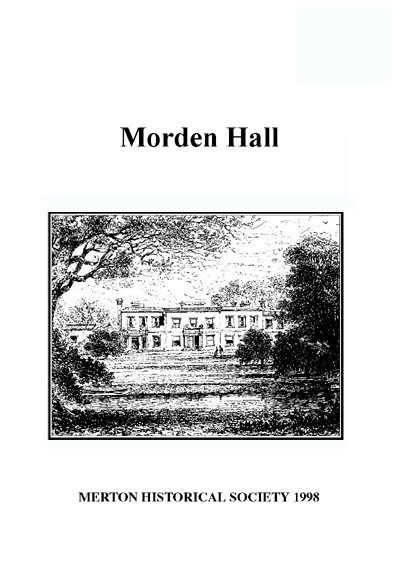
In this booklet Bill Rudd recounts the history over more than 400 years of the building and the two principal families connected with it, the Garths and the Hatfeilds. Illustrated with drawings, maps and a family tree.
Morden in 1838: The Tithe Apportionment Map

The tithe apportionment for Morden, which is the earliest for the four ancient parishes which make up the present London Borough of Merton, dates from 1838. It is also one of the most detailed, covering every property in Morden, and providing field names for almost every field. The map identifies each field and building with a number, and the accompanying schedule also gives the name of the owner and the occupier, its area (in acres, roods and perches), and, in most cases, the use to which it was put.
Morden in 1910: The Land Valuation Records (‘Lloyd George’s Domesday’)
A unique view of Morden just before it was overwhelmed by suburbia. Every property, including building plots, is listed, with details of owner, occupier, leases and rents. Many properties have full descriptions, some with plans. The original maps are missing but Rosemary Turner has reconstructed them and plotted each property onto the 1912 OS map.
Morden Manorial Account Rolls
A major source of information for the study of the manorial economy is the sequence of manorial account rolls that begins in 1280. Though there are many gaps – no accounts survive for the period 1359-1387 or from 1412-1440, and only a dozen thereafter – over 100 can be consulted at the Muniment Room (WAM), a dozen at the Society of Antiquaries London (SAL), and one at the Bodleian Library in Oxford.
Morden Manorial Court Rolls
A number of manorial court rolls survive, though many are missing. Those covering the period 1296-1300 and for 1327-28 are in the Muniment Room at Westminster Abbey, while the British Library has those for 1378-1422, 1435-58, 1461-1503, 1507-9, 1512-29, 1534-43, and 1655. Extracts and copies of entries from 16th-century court rolls can be found at the British Library, at Lambeth Archives and at Surrey History Centre, which also holds the court rolls from 1594 to 1901 and a 1535 Steward’s memorandum of the rents and other payments made at the manorial courts.
Morden Manorial Leases
From 1359 the abbey’s demesne at Morden was leased to tenant ‘farmers’. Unfortunately the early manorial leases have not survived, but the abbey’s Registers or Lease-Books, dating from 1485, contain copies of the last three leases of the demesne at Morden. The final lease of 1511 included the rectorial tithes of the parish, and the right to hold manorial courts, in addition to the lease of the demesne lands of the manor. It was for 60 years, and was subsequently assigned to other lessees. Surrey History Centre has two assignments of this lease, as well as sub-leases of the tithe corn.
Morden Manorial Records
Westminster Abbey had owned an estate in Morden (usually spelt Mordon) from before the Norman Conquest. It is fortunate that many of the medieval manorial records are still in existence, mostly in the Muniment Room at Westminster Abbey, though some documents have found their way into other archives. Translations of all the known documents have been added to this website and can be viewed or downloaded from these pages. Images of these documents have also been added alongside the translations, by courtesy of the various archives.
Morden Park
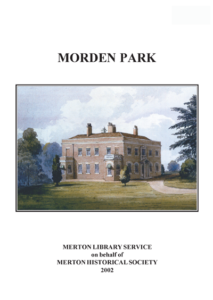
A booklet on Morden Park, by former Borough librarian Evelyn Jowett, was published by Merton Historical Society in 1977, but has long been out of print. Since then further information has come to light, not least during the survey undertaken prior to the renovation and conversion of the house for use as Merton’s Register Office. This new edition has been prepared by William Rudd and Peter Hopkins of Merton Historical Society.
Morden Park Golf Course
Click on the Audio clip to discover more about the origins of the golf course.
More Memories of Manor Road in the 1920s Mitcham
Constance Pope’s reminiscences of the 1920s in Manor Road, published as Local History Notes 2, aroused considerable interest. In this, her second set of recollections, she gives “a sort of biographical account of life as a child going to school, describing the surrounding buildings and the people who lived in them.” Her account is complemented by delightful pen-and-ink sketches of the properties mentioned in the text.
Motspur Park and West Barnes Memories 1920 to 1947: Collections & Recollections
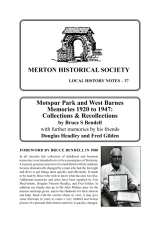 Local History Notes 37: by Bruce S Bendell, with further memories by his friends Douglas Headley and Fred Gilden. Written in 1988, these memoirs were lodged with Merton Local Studies Centre. They recall Mr Bendell’s memories of first visiting grandparents in the West Barnes area of Merton, and then moving there as a child until his marriage in 1940. His recollections of walks with his brothers in what was then countryside are especially vivid. He particularly remembers his work at the knitting factory of Boulanger, in Seaforth Avenue. He also details the development of the local housing estates between the Wars.
Muriel Remembers
Click on the Audio clip to hear Muriel’s memories of growing up in Arundel Avenue.
New Cottages, Lower Morden Lane
Click on the Audio clip to hear Madeline describing the cottages.
Not Trampled But Walked Over
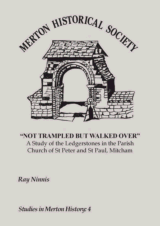
A Study of the Ledgerstones in the Parish Church of St Peter and St Paul, Mitcham
The ledgerstones (inscribed flagstones used to seal graves and vaults) in Mitcham parish church have been concealed under the carpeted floor since 1991. Fortunately Ray had photographed many of them, and had copied the inscriptions, shortly before they were covered, and this book reproduces this material, together with biographical notes. This book is a must for local and family historians.
On the Wandle
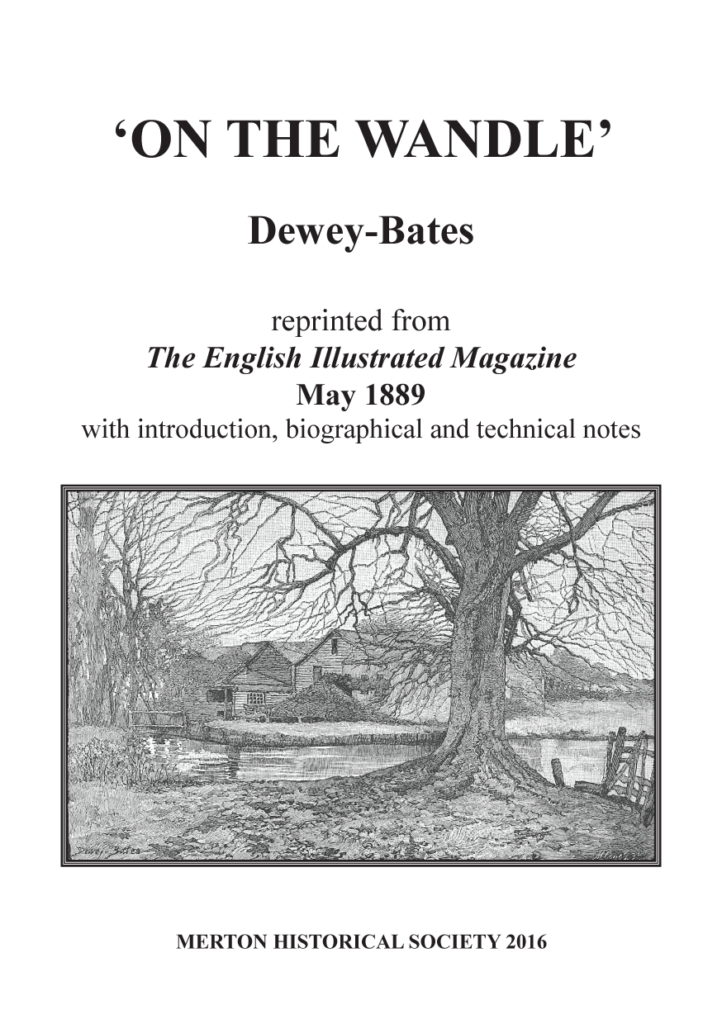
On the Wandle is a reprint from the May 1889 edition of The English Illustrated Magazine of an illustrated article by the American artist Dewey Bates (1851–1898). It also includes extensively researched technical and biographical notes by David and Katharina Haunton.
Once Upon a Time: Recollections of an Edwardian Childhood in Colliers Wood
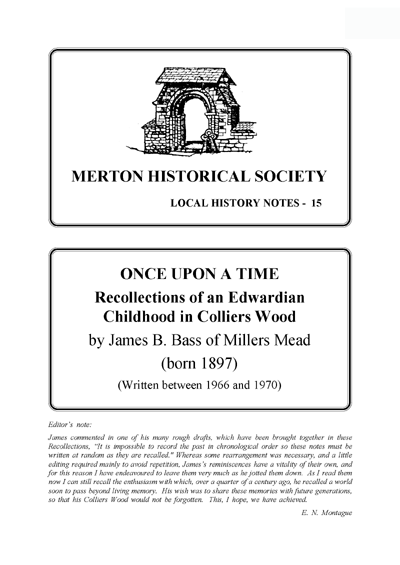
These engaging reminiscences, put on paper between 1966 and 1970, have been edited by Eric Montague. Mr Bass, who was born in 1897, recalled with affection the ‘compact community’ of early 20th-century Colliers Wood, the games, treats and semi-rural pleasures of childhood in the days of horse-buses; the annual highlights of Epsom Week and Sanger’s Circus; and the coming of the electric tram and the cinema.
Other Sources
More local history publications can be obtained from the following addresses:-
OUR CONVICT SON: Harold Brewster 1895-1958: A Merton Objector to Conscription
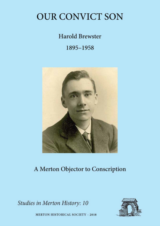 In March and April 1916 Harold Brewster, a surveyor’s assistant employed by Merton and Morden Council, argued his case in front of two tribunals that no earthly court had a right to come between a man and his conscience. His conscientious objection was to the undertaking of all forms of military service. Resisting conscription exposed him to the hostility of the majority of the population and to the penalties, short of death, that military and civil rule could impose.
In this study, Keith Penny traces the full range of the penalties that young Harold Brewster endured in the name of conscience.
Parish Records
The Parish Registers for Morden and Wimbledon to 1812 were transcribed, indexed and published in the early 20th century.