 MERTON HISTORICAL SOCIETY
 MERTON HISTORICAL SOCIETY: CELEBRATING 75 YEARS 1951-2026
Carrie Lynott
 Just a year ago, we advertised for a ‘budding researcher’ to write the story of Merton Historical Society in time for our 75th anniversary, hoping we could encourage an interest in history and research. We envisaged a young university student, perhaps, or a retired person attending night classes. Carrie Lynott, an A-level student in history and art, has produced a text well beyond our expectations, looking closely not just at MHS and its members, but also at the Society’s role in the local area, and within the national scene.
We are proud of what the Society has achieved, and proud of Carrie’s work. May their legacy last well into the future.
Christine Pittman, Chairperson, Merton Historical Society (August 2026)
1951-2026
Carrie Lynott
MERTON HISTORICAL SOCIETY 2026
Preface
Just a year ago, we advertised for a ‘budding researcher’ to write the story
of Merton Historical Society in time for our 75th anniversary, hoping we
could encourage an interest in history and research. We envisaged a
young university student, perhaps, or a retired person attending night
classes. Carrie Lynott, an A-level student in history and art, has produced
a text well beyond our expectations, looking closely not just at MHS and
its members, but also at the Society’s role in the local area, and within the
national scene.
We are proud of what the Society has achieved, and proud of Carrie’s
work. May their legacy last well into the future.
Christine Pittman, Chairperson, Merton Historical Society
August 2026
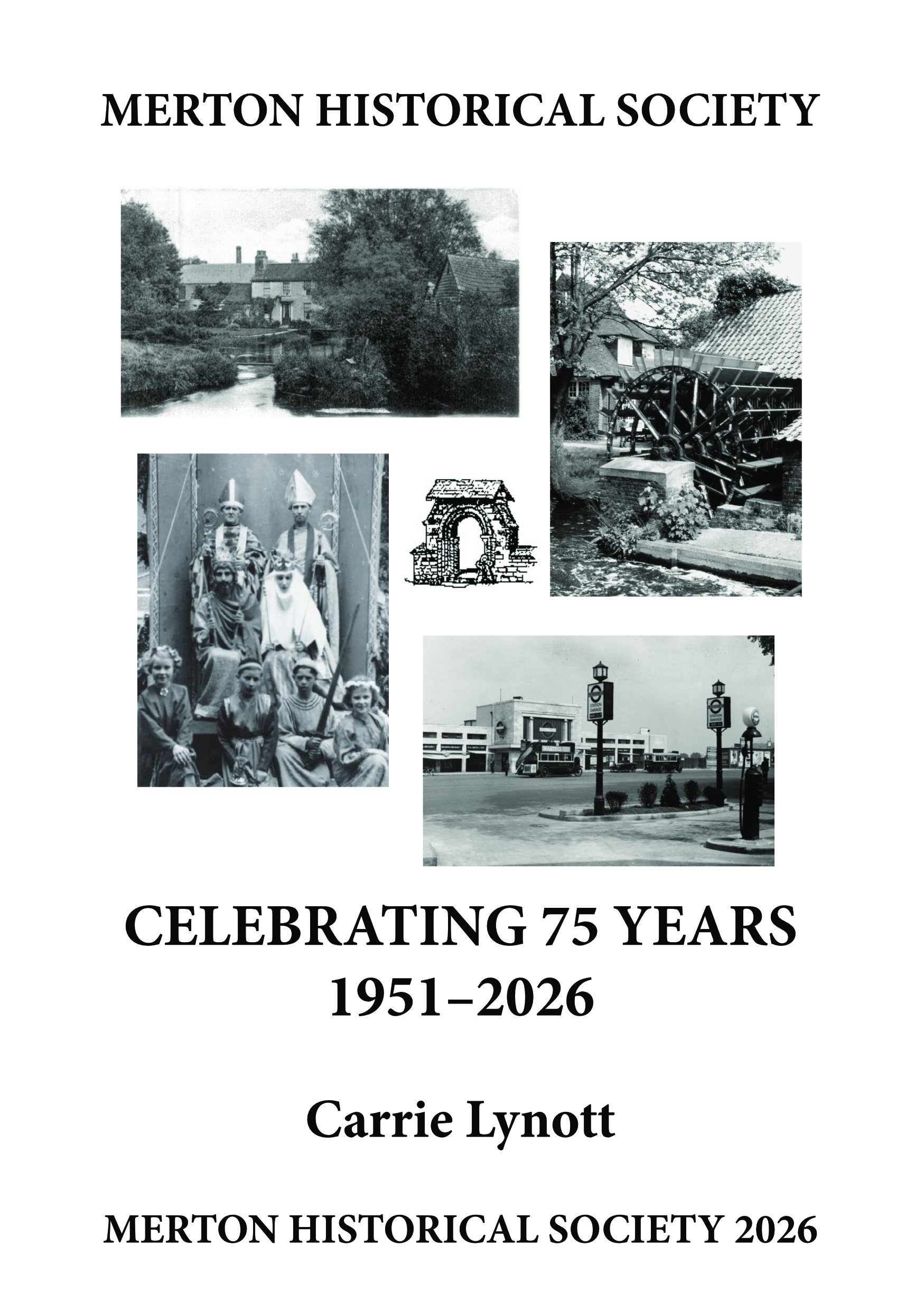
Cover images: clockwise from top left: Crown Mill and cottages, Mitcham; Liberty
waterwheel, Merton Abbey; Morden Underground Station; the Coronation float
2
Beginnings
Across its 75 years, Merton Historical Society has acted as a cornerstone
of the borough’s preservation and celebration of local history. The Society
has served as a unifying force within the community, important for
sharing an appreciation of Merton’s heritage, all the while adapting to the
challenges of an ever-changing urban landscape. By looking at the
publications, outings, workshops and the roles of crucial members, it
becomes apparent that MHS plays an essential role in advocating for the
area’s heritage and has become a vital instrument in its preservation.
From perpetuating the memory of Merton’s history to uniting the locals,
new and old, it has become a symbol of inclusion, local interest and
historical endeavour.
With coach trips to explore historical locations, publications to celebrate
the rich history prevalent in Merton and the surrounding areas, and
projects to enrich the community’s interest in its roots, MHS provides
extremely valuable opportunities to learn more about the area you live in
and immerse yourself in the area’s heritage.
To appreciate the extent of the Society’s impact, we must take ourselves
back to 1951, when MHS was founded, then called Merton and Morden
Historical Society. Morden Underground Station opened on 13
September 1926, almost exactly 100 years ago now, catalysing the rapid
development of Merton and Morden. People were able to travel from
3
neighbouring towns and the surrounding Surrey countryside to come
and explore the wide variety of shops that could be found in Morden by
the 1950s. However, this structural evolution started to replace the
previous landscape and suburbia obscured the memory of older ground.
Merton was becoming a far more suburban district. 1930s Art Deco
buildings, such as Morden Odeon,
characterised the modern landscape
and the high street comprised a plethora of shops. From banks to clothing
stores, food shops, chemists, florists, newsagents, tobacconists, and more,
there was much to draw residents and commuters alike. So, with the area
rapidly evolving, aspects of the past were at risk of being forgotten, in
desperate need of commemoration.
However, what coincided with this urban development is equally
important. The Festival of Britain in 1951 was a nationwide, government-
sponsored exhibition and art festival. Designed as ‘tonic for a worn-out
nation’, its purpose was to showcase British technology, arts and science
following the austerity of World War II. It also marked the centenary of
the Great Exhibition, which was an international display of the arts and
sciences that took place from 1 May to 15 October 1851. In the same way,
the Festival of Britain celebrated the progress of industry that had been
given the chance to flourish since the war. It was this cultural pride that
enabled the history of Britain’s localities to be included within the
4
Festival’s celebrations. This created an opportunity for the national
renewal that the government was striving for, while embracing the rich
stories that made up the area’s past.
Merton and Morden Urban District Council set up a committee to
organise the local celebration of the Festival, bringing together a
formidable force of like-minded people who were eager to honour the
rich history of the area. The District Librarian, Miss Evelyn Jowett, was
tasked with compiling a history of the district, leading her to extensive
research into the area’s roots. This also coincided with a series of lectures
on local history by Mrs Saynor as part of the Workers’ Educational
Association. With the council’s formation of a committee deeply invested
in the history of their local area, the decision was made to establish a
permanent society. Thus, Merton and Morden Historical Society was
founded on Wednesday 28 February 1951, supported by several District
Councillors and scholarly enthusiasts who genuinely loved local history.
Colonel Bidder, already a prominent local historian, was elected as
President, and named the first honorary member. Perhaps his most
notable work was his excavation
of the Ravensbury Anglo-Saxon
cemetery in 1891 and 1922, and
his renown as an archaeologist
made him the ideal candidate for
President, a position he went on to
hold for twenty years. He was also
recognised for his pioneer work at
Merton Priory, uncovering the
ground plan of the church and
chapter house in 1922; this site
became very close to the Society’s
heart and intrinsic to some of their
later work.
Now officially formed, the nascent Society gathered for their very first
meeting. Elected Chairman when the Society was founded, Councillor
Vincent Talbot introduced the inaugural meeting by apologising for it
being the first, reasoning that it should have been the 21st or the 51st.With
5
the feeling that the formation of the
Society was long overdue, it quickly
gained traction and with the help of
advertisements,
such as those in
the Wimbledon Borough News,
membership had already grown to
70 by 1952.
In that same year, An Illustrated
History of Merton
& Morden, written
by Miss Jowett,
with the assistance,
among others, of
the very young
Lionel Green was
published.
This publication, therefore, not only marks Merton and Morden’s
celebrations of the Festival of Britain, but also the driving force for MHS’s
creation 75 years ago.
Early members
We must honour especially two
founding members and all their
efforts throughout their time as
part of the Society. Firstly, as one of
the main instigators of the Society’s
formation, Miss Jowett was a vital
member for many years, serving
for 25 years as Honorary Secretary.
She had an impressively extensive
knowledge of the district’s history,
aided by her role as Urban District
and then Assistant Borough
Librarian. This led her to write
many articles and publications for
the Society. For many years, she
6
also shared her knowledge through a series of lectures on behalf of the
Education Department’s Adult Education programme – a symbol of her
devotion to the history of the area and its teaching. It is undeniable that
Miss Jowett is one of the people to thank for the development of MHS as
we know it today, and her legacy was rightfully marked for many years by
an annual Evelyn Jowett Memorial Lecture in her honour.
Secondly, we must remember longstanding
member, Lionel Green. As
a young man, Lionel joined an adult
education class in Merton, studying
local history. When the decision was
made to publish An Illustrated
History of Merton & Morden, Miss
Jowett commissioned him to write
four chapters: one on Merton Parish
Church, of which he was a member;
one on John Innes, a local property
developer and philanthropist, and
two on Merton Priory. This work
was described as ‘the first flowerings
of a lifelong interest’. Over the years, he went on to write numerous
articles, an MHS booklet The Railways of Merton (1998), and the MHS
paperback volume on Merton Priory, A Priory
Revealed (2005). He also participated in a wide
variety of the Society’s activities across his many years
of service, taking on the roles of Chair, Vice President
ISBN 1 903899 52 4MERTON economic and social significance in local, national and European affairs.
Merton Historical Society,
founded in 1951, has always had a respected reputation for its publications on aspects of the history of the present London Borough of Merton.
www.mertonhistoricalsociety.org.uk
Arms of Merton Priory(a modern copy reproduced by courtesy of W J Rudd)
of London, blue badge .
This book a charitable spearhead www.and President. After his
untimely death in 2010, this
quote, initially from a
description of Gilbert, the
founder of Merton Priory,
was used to describe Lionel: ‘As everyone who
knew him would confirm, it is impossible to
overestimate the respect in which he was held, so
much was he loved, esteemed and praised’.
7
The early years of the Society were a time of exciting growth.
The first
AGM took place on 2 November 1951, with 42 members present and 58
with a paid membership. By this time, the reported funds consisted of £3
16s 10d (£3.84). This led Treasurer Mr Cobbett to remark that he thought
the Society could officially afford to buy a spade to begin a dig in Morden
Park. Although this suggestion was perhaps slightly jovial, they did just
that, with archaeological excavations beginning on Stane Street in
Morden Park in the autumn of 1958 and the spring of 1959, led by Dennis
Turner. This marked the first of many archaeological digs that MHS
carried out across its 75 years.
The Society also played a part in the local Coronation Carnival on 6 June
1953. Some 700 years prior to the carnival, it was Merton Priory that
hosted King Henry III’s great council a few days after the marriage of the
King to Queen Eleanor in Canterbury and her coronation at Westminster.
So, as part of their carnival float, Society members were decked out in
Plantagenet costumes; Norman Black was chosen as their Henry III,
while Lionel Green featured as one of the black-robed canons of Merton
Priory. A request was sent out to members for old sheets, bedspreads,
curtains, voluminous skirts and ribbons to fashion their elaborate,
8
although perhaps not luxurious,
costumes. Nevertheless, with their
spectacular re-enactment of this
Plantagenet tableau, Merton and
Morden Historical Society, of
course, won first prize and
received the handsome sum of ten
guineas.
Less glamorous but just as
important activities undertaken by
members included the washing of
masonry from Merton Priory
found in the River Wandle in 1956,
as seen in this photograph donated
by early member Mike Nethersole.
Developing MHS
Fourteen years after the Society’s creation, 1965 marked a significant year,
with the introduction of the quarterly Bulletin. In April 1965, Chairman
Arthur Turner introduced the Bulletin to members, writing that ‘This is a
9
new venture, and it is the first of which your committee hopes will be a
regular quarterly bulletin which will help to keep you informed of our
past activities together with advance news of future meetings, of interest
to our members and their friends’.
June 2026 marked the 238th edition of
the Bulletin, which through the years has carried articles on Merton
history, reports of the Society’s activities, messages from the Chair and a
few gentle reminders to pay subscriptions, keeping members involved
and informed of the Society’s latest news and events.
The year 1965 also marked a change in name for the Society, prompted by
the amalgamation of the Municipal Boroughs of Mitcham and
Wimbledon and the Merton and Morden Urban District to form the
London Borough of Merton. This led to the Society’s change of name,
announced in the January 1966 Bulletin, from Merton and Morden
Historical Society to Merton Historical Society (MHS). As recorded in
the Bulletin, the Society’s meeting ‘unanimously agreed that the name
should be adopted forthwith.’ Much of the responsibility for recording the
history of Wimbledon was left to the Wimbledon Society, which had been
founded in 1903, but from then on, MHS’s work extended to include the
historic parish of Mitcham.
10
The Society has worked hard to preserve historical sites and protect the
area’s rich past for generations to come. However, facing an ever-
changing world, the development of the area has often come at the cost
of the loss of its heritage. As mentioned above, Colonel Bidder had
revealed the outline of Merton Priory church in 1922. Gilliat Hatfield
then generously bought a plot of land near the site of the high altar,
conveying it to the Urban District Council, in order to preserve the
memory of the Priory for years to come. The Society funded a
commemorative stone to mark the site in 1958, sculpted by Mr Blackwell
and including the outlines of the site identified by Colonel Bidder’s
findings in 1922. Merton College Oxford subscribed £25. Colonel
Bidder, by then President of MHS, unveiled the memorial on 25 July
1959, erected by the Council within a small enclosed garden, to mark the
celebration of one of Merton’s richest sources of history. However, as
Merton was developed, new buildings replaced earlier industrial
structures in the area, and now the remains of the foundations of the
Priory church are preserved beneath Sainsbury’s car park.
11
The Society’s early hopes that the priory site could be preserved as a
heritage park were disappointed, though in fact the development enabled
detailed excavation of the site, leading to a richer understanding of life at
the priory.
However, the site is now commemorated by Merton Priory
Chapter House Museum, which displays the foundations of the chapter
house together with some artefacts and historical information. MHS’s
efforts over the middle years of the 20th century helped bring the Priory
site into the public eye after it had been forgotten for centuries.
Another challenge the Society has faced is the storage of its archive,
involving several changes of locations over the years. For example, in
1978, the archive had to be moved out of Gorringe Park Avenue in
Mitcham. Later, when the collections were stored in one of the top rooms
of The Canons in Mitcham, members were provided with a chance
to explore this historic site. Ultimately the Council was no longer
able to provide suitable storage accommodation, resulting in the
dispersal of most of the Society’s possessions, its archaeological finds and
other important items being deposited in more appropriate archives.
Only recently was the Crown Inn
sign from Morden returned to its
original location, as Merton Local
Studies Centre now stands over the
site of the old inn. Nevertheless,
the moving of the Society’s
collection did result in the
opportunity for members to
reminisce and observe all the
artefacts that had been collected
over the years, rousing fond
memories for all involved.
In 2001, MHS celebrated its 50th
anniversary, marked by an
Anniversary Exhibition held at The
Canons between 20 and 25
February, at the invitation of
Merton’s Heritage Officer, Sarah
12
Gould, and coordinated by a special
committee led by Bill Rudd.
Memorabilia were
displayed, including
meticulous member-
lists and cashbooks
of the Society’s early
days, as well as copies
of all the previous
Bulletins (then 136
issues).
The displays included
photographs of the
M&MHS Players and
the 1953 Coronation
Carnival float, maps
13
and artefacts from archaeological digs that the Society had participated
in, and a photographic survey of Morden compiled by Bill Rudd.
The new publication, The Cricket
Green by Eric Montague, was also
launched at this event, as seen
being held by Chairman Lionel
Green and the Mayor of Merton,
Ian Munn.
One hundred non-member visitors
attended, contributing generous
donations, and a buffet lunch was
enjoyed on the Saturday.
14
Thirty seven members and guests, including the Mayor and Mayoress of
Merton, as well as Merton Heritage Officer Sarah Gould, then enjoyed a
50th Anniversary Dinner on 28 February, held at the Morden Hall
Beefeater Restaurant. The evening was fittingly concluded by speeches
from Chairman and founding-member Lionel Green, as well as the
Mayor. The Annual Anniversary Dinner then became a key date in the
Society’s calendar for many years. This event, later becoming an
Anniversary Lunch, still holds fond memories for many members. Held
at the end of February to mark the passing years of the foundation of
MHS, it has also acted as a symbol of the community and friendship the
Society has fostered. For several years, it was held at Morden Hall, then
later at the Catering School of Merton College and finally, the Cavatoro
Restaurant in Mitcham, all the while supporting the local businesses of
the borough.
Officers of the Society
From MHS’s first Chair in 1951, District Councillor Vincent Talbot, to the
Society’s Chair in 2026, Christine Pittman, there have been a number of
people working tirelessly to facilitate the Society’s operations. They have
contributed by writing publications, keeping members updated with
annual reports in the Bulletin,
as well as chairing the regular meetings.
Arthur Turner was the Society’s longest standing Chairman, serving for 19
years in total, from 1961 to 1978, as well as from 1983 to 1985. After
Arthur’s 17-year term, it was decided that new rules should be put in place
to allow more members to take on a leadership role in the running of the
Society. From then on, the Chairs usually served a three-year term,
encouraging new members to become part of the committee and allowing
previous Chairs to pass on their expertise to the up-and-coming members.
In addition to Chairpersons, the Society has had four Presidents over the
years, the first being Colonel Bidder from the founding year, followed by
Viscountess Hanworth, then Scott McCracken, Lionel Green being the
most recent, up to 2010. The first three Presidents were chosen because of
their involvement in excavations at Merton Priory, while Lionel’s
longstanding research into the priory ensured his appointment. Colonel
Bidder, for example, had been an active archaeologist, initiating
15
excavations of the Ravensbury Anglo-Saxon cemetery in 1891 as well as
Merton Priory church in 1922. This deep interest in and passion for the
history of the area, especially archaeology, made it natural for him to
become MHS’s first President when it was formed.
The longest-serving President, remaining in post for 27 years, was
Viscountess Hanworth. Part of the Auxiliary Territorial Service during
World War II, she became not only a long-standing representative of the
Society, but also a nationally esteemed archaeologist, well-known for her
work at the Rapsley Roman villa. She encouraged the Society’s volunteers
in the excavations of the Roman villa in Binscombe in 1971, and was
actively involved at Merton Priory in 1976-7. After stepping down from
the Presidency she served the Society as Vice President, from 1998 until
retiring in 2012, aged 93. She was known for her ‘unexpected sense of fun’,
driving to archaeological digs in her Morris Minor, as well as, of course,
being revered for her dedication to local history and archaeology.
The position of Vice President was created in 1976, in recognition of Miss
Jowett having served as Honorary Secretary since the Society’s inception
in 1951, and she continued to play a significant role in its running. Two
years later she was joined as a Vice President by Arthur Turner, another
16
key member.
In due course this role was shared by Lionel Green, and
later by Eric Montague and Bill Rudd. Judith Goodman was the most
recent member to hold the position of Vice President, serving for six
years, until 2021. The role allowed key members, who had gained
valuable experience over their years as members and on the Committee,
to maintain an important role in the Society in which they were so
deeply involved.
Arthur Turner must first be recognised as the longest serving Chair.
When he retired as Chair in 1978, he was described as an incredibly
dependable presence, with the number of missed visits or meetings able
to be counted on one hand. During Arthur’s time as Chair, the
membership of the Society rose from around 60 members to almost 250.
He produced all the Bulletins from 1965 to 1978, and his time as Chair led
to eight new publications being released. Even after stepping down as
Chair, he agreed to continue as Vice President.
Another key individual was Eric Montague, known as Monty to his
friends, who joined MHS in 1965, and remained a member until his death
in 2016. During that time, he played a pivotal part in the Society’s
archaeological excavations. The most notable of these was the excavation
of Long Batsworth in Phipps Bridge in 1965 in conjunction with Surrey
Archaeological Society. Despite MHS becoming less involved in the
increasingly professional industry of archaeology, Monty’s passion did
not suffer, as he gained a diploma
in both Archaeology and Medieval
History, as well as a Master’s degree
in Local History. His interest in
history was demonstrated by
research projects, talks, and
publications, as well as being the
go-to person for any questions
about Mitcham history. In fact, his
14-volume publication under the
series title Mitcham Histories,
published between 2001 and 2013,
is a reference point for all enquiries
17
into the history of Mitcham. Additionally, Monty compiled a large
collection of photos, now available as the Eric Montague Collection on
the Society’s website. These provide a visual history of Mitcham, mostly
during the 1960s and 1970s, illustrating the changes the area has
witnessed. It was written that he was ‘to put it simply, a true gentleman,
charming, kind and always ready to offer support,’ as demonstrated in his
diligent efforts to foster interest and knowledge in the area’s heritage.
William Rudd, known as Bill,
joined the Society in May 1962 and
was Vice President from 1997 until
2014. He played a crucial role in
the Society, taking part in many of
the early archaeological digs and
writing numerous articles and
publications, such as his 1998 work
encompassing over 400 years of
Morden Hall’s history. As with Eric
Montague, he contributed greatly
to the photographic archive of the
Society, with the Bill Rudd
Collection featuring several thousand photos now available on the
Society’s website, mainly of Morden, from the 1950s to the 2000s. This
collection offers a brilliant array of photographic evidence of the Morden
and Merton area across the decades. His contribution was notable, with
the Bulletin in 1978 claiming that ‘If there is any hard work to be done, it
is a certainty that Bill Rudd will be in the first line’.
He was undoubtedly
dedicated to MHS, perhaps best exemplified by his mission to collect any
unwanted artefacts. Throughout the years, he salvaged a myriad of
objects, from railway lamps to station signs and signposts, earning him
the reputation of a historical magpie.
Judith Goodman moved to Merton Park in the late 1980s, where she
developed an interest in local history. Judy was much involved with the
Society – she served as Chair for three years (2005-08), and then for a
further two as Vice Chair. She reluctantly became Vice-President (2015-
2021), as she had ‘not done enough original research’. Previously she had
18
served on Committee from 1990-
91 to (officially) 2004-05, but was
frequently co-opted thereafter. In
addition, Judy was a highly
competent Bulletin Editor for 18
years, from no.120 in December
1996 to no.192 in December 2014.
She confirmed the Bulletin size at
16 pages, and, with no.166 June
2008, introduced what is still the
standard format of picture and
contents for the front page.
Her own articles included ‘The Wandle in Literature’, an occasional series,
which she began with a book by Sir Humphry Davy in no.149, and later
discussed figures such as Kipling, Ruskin, John Betjeman and Carol
Rumens. She took particular satisfaction in exposing the 19th-century
editor who inserted a spurious mention of ‘spotted Wandle trout’ into
later editions of Izaak Walton’s Compleat Angler. Her frequent articles,
long and short, covered a wide range of subjects (eg. parish voting, an
Anglo-Saxon Ealdorman), usually of people rather than architecture. She
enjoyed picking up odd sources of information (such as Gertrude Jekyll’s
garden notes, and a poem a reader had saved from a local newspaper),
and bringing out their local significance.
She was a leading member of the MHS editorial committee, having a
sharp eye for grammatical errors and ambiguous expression, and
developing the house-style for publications. Her work in transcribing Bill
Rudd’s handwritten text for Abbey Roads into digital form was a major
achievement.
Her major publications include Merton & Morden, A Pictorial History
(1995, Phillimore) and Coal and Calico: Letters and Papers of the Bennett
and Leach families of Merton and Wandsworth (2008, MHS), as well as
numerous contributions to the John Innes Society, notably Merton Park –
The Expanding Suburb (1998) and Dorset Hall 1906-1935 (nd.), about
Rose Lamartine Yates.
19
Another key member in recent
years was David Haunton, known
generally as Dave. Dave joined the
Society at the end of August 2007
and he very quickly immersed
himself in all the Society had to
offer. In fact, he had already
written an article about Merton’s
efforts during World War II within
his first month, exemplifying his
enthusiasm, especially regarding
the area during the Second World War. This article in particular
concerned the pilotless aircraft developed by Walter Lines that aided
Merton’s contribution to the war effort, reflecting Dave’s lifelong interest
in planes and their workings. Having been a member for over four years,
he became Chairman of the Society, serving his tenure between 2011 and
2014. Many members shared their fond memories of his time spent with
the Society, in particular how he once rented a Landmark Trust property
in East Grinstead for a family holiday and invited everyone to join him for
a day’s visit. The East Grinstead local historical society gave them a guided
walk, providing all present with a wonderful opportunity to explore a new
area, enriched by the expertise of local historians. Dave was also
appreciated for his encouragement of new members, showing them the
importance of knowing the history of the area in which they lived and
inspiring them to find out more. Finally, members fondly recalled
watching the twinkle in Dave’s eye, accompanied by a slight tremor, as he
tried to suppress his laughter when a frustrated speaker was battling with
some rather uncooperative technology. This combination of enthusiasm,
generosity and humour demonstrates how valuable Dave was to MHS,
and how dearly his memory is treasured. In addition, it is worth noting
that after the incident with uncooperative technology, the Society
invested in some new kit! After Dave stepped down as Chairman in 2014,
he took over as the Editor of the Bulletin, overseeing them all from
number 193 in March 2015 to number 234, ten years later, in June 2025.
20
Membership
Membership numbers have varied over the years, starting with 84
members after the first year and reaching an all-time high in 1974 with
245 members. In recent times, numbers have stayed steadily well over
100. Members receive printed copies of the quarterly Bulletins and a 20%
discount on MHS publications, while also benefiting from being able to
attend the Society’s events and workshops. MHS, as a Society, is a
member of the British Association of Local History, meaning that its
members have access to the quarterly magazines, newsletters and
discounts at BALH events.
Small adjustments to membership have been made along the way, such as
in 1955, when the committee proposed that a husband and wife could
subscribe to a joint membership and in 1956, when membership cards
were issued. Later,
discounted prices for student membership and
additional members of the same household were also introduced.
Over its 75 years, MHS has had numerous Membership Secretaries,
issuing countless reminders via the Bulletins to pay subscriptions. The
price of membership has, of course, had to rise over the years to keep up
with inflation. The initial cost of membership in 1951 was 2s 6d (12.5p),
whereas in 2026 it stands at £12.
Legacy
An example of the Society’s legacy can be found in Mostyn Gardens, in
the heart of Merton, where four oak trees were planted in 1973 . This was
funded by the Society’s donation of £16 during the national campaign of
Plant a Tree Year.
The Society also played a role in a Time Team documentary for TV, aired
on Channel 4, on the excavation of Merton Abbey Mills in 2003.
The history of Merton has been made far more widely accessible, even to
non-members, by the introduction of the Society’s website, first proposed
at the AGM of November 2002. Crafted by Society members, the website
offers an abundance of photos, lists of publications, the Society’s quarterly
Bulletins from 1995 to present day, and much information on the area of
Merton, today and in times gone by.
Provided in a digestible and
21
22
engaging manner, this venture has significantly improved the public’s
access to the historical resources MHS has to offer.
For many years MHS has participated in the annual Merton Heritage
Discovery Day at Morden Library, an excellent opportunity to showcase
the Society’s ongoing researches and publications, to advertise its events
and to catch up with fellow enthusiasts in the Borough. This continues a
long tradition within the Society of arranging exhibitions of its work and
research at the Heritage Centre and in local libraries and other venues.
For Civic Week in 1962, MMHS
arranged an exhibition of historic
photographs in the Central Library
lecture hall, and also produced
a model of Merton Priory, as
envisaged at that time. Using data
supplied by Miss Jowett and
Dennis Turner, it was constructed
by Mr JH Burchett of Morden
Library, and painted by member
Michael Nethersole.
The most recent exhibition was Irene Burroughs’ display The Physic
Gardens of Mitcham, held at Mitcham Library in 2026, based on her 2024
booklet of that title, filled with her
own original paintings and
drawings. Other events to advertise
the Society’s research to a wider
audience include the launch of
Karen Ip’s paperback book, Miss
Tate and her Almshouses, at
Mitcham Parish Church in 2025.
Memories
MHS has provided many treasured memories for its members, as
reflected in the member surveys that were collected as part of the research
into this publication. For example, when the 18th-century house in
Morden Park was renovated in 2002 to become the borough’s Register
23
Office, the Society was asked to update Miss Jowett’s
study of Morden Park, published in 1977, using new
sources made available during the renovations. Bill
Rudd and Peter Hopkins were invited to combine
their research and produce a new and colourful
booklet on behalf of Merton Library Service,
elaborating upon the earlier research of Miss Jowett.
When the booklet was launched at one of Morden
Park’s open days, Bill and Peter were not only able
to talk to visitors but also to explore the house from
top to bottom. This provided them with an unparalleled opportunity,
especially given the house was a historic site within the area and one that
featured in the childhood memories of many of the local residents.
The Society has provided opportunity for members to find out about the
area that they grew up in or have moved to, reflecting the true purpose of
MHS: to cultivate an interest in the past of one’s surroundings. One
member reminisced about learning at a workshop that there were
remains of a medieval mansion in the woods behind the house where they
lived when growing up on the St Helier Estate. This is something that they
would have otherwise never known.
Onto more recent memories, it was also fascinating to hear from
members who hadn’t been part of the Society for very long, but have
clearly valued the opportunities they have been given in the time since
they joined.
Although thankfully social distancing during the COVID-19 pandemic
has faded into the distance, members still talk about a committee meeting
held outdoors during this time. Carefully observing current social-
distancing rules, proposals for new publications were accompanied by the
noise of circulating traffic outside
Wandle Industrial Museum.
Some recall many interesting trips
over the last several years, with a
guided tour of Kingston in 2018,
which included a visit to David
Mach’s piece ‘Out of Order’, a staple
24
of the town’s culture, as well as an
accidental meeting with the Mayor.
The trip ended with a visit to the alley
dedicated to the most famous and
beloved resident of Kingston, Nipper,
the dog whose image became the logo
of HMV records. Also in 2018, the
Society organised a visit to Kneller
Hall, which was the site of training for
military musicians until 2021. More
recently, members have visited a
bookbinder’s workshop in London, as
well as the Post Office railway, which
was remembered as being a slightly
awkward place for those over six feet
tall! In earlier times the Society
arranged coach trips to places such as
Hatfield House, where this photo was
taken, as well as weekends away.
Over the years, the Society has adapted to the changes in members’
interests and the increasing costs of events. The Society’s programmes no
longer offer the eight mile rambles in the Surrey Hills, historical reenactments,
amateur dramatics or the archaeological excavations.
Instead, MHS focuses its resources on activities that will appeal to its
members and are feasible in terms of cost and organisation. For example,
the Society is successful in its history workshops held at Wandle
Industrial Museum, attended by recent as well as longstanding members,
all interested in the study of the local past.
25
Offering its collection of publications for sale to all via the MHS website,
the Society provides support and encouragement for individual research
into the history of our area. Members who have joined recently are maybe
new to the study of the past but realise the impact that it has on today.
Recognising the importance of the preservation of our historic past, they
seek advice and information from the Society.
It is hoped that this publication is a fitting celebration of the 75 years of
the Society’s history and can serve as inspiration for many more to come.
26
Sources used
Bruce, P. and Mason, S. (1993) Merton Priory. Museum of London Archaeology
Service
Green, L. (2005) A priory revealed using material relating to Merton Priory.
Merton Historical Society
Jowett, E. (1951) An Illustrated History of Merton and Morden. Merton and
Morden Festival of Britain Local Committee
Jowett, E. (1977) Morden Park, Morden. Merton Historical Society
London Borough of Merton (2026) Merton Memories Photographic Archive:
Morden town centre in 1949. Available at: https://photoarchive.merton.gov.uk/
moctre1949 Accessed 5/6/2026
London Museum (2026) Festival of Britain 1951. Available at: https://www.
londonmuseum.org.uk/collections/london-stories/Festival-britain-1951/
Accessed 5/6/2026
London Museum (2026) The Great Exhibition 1851. Available at: https://www.
londonmuseum.org.uk/collections/london-stories/what-was-great-exhibition1851/
Accessed 5/6/2026
Merton Historical Society (1965 – present) MHS Bulletins. Available at: https://
mertonhistoricalSociety.org.uk/ Accessed 5/6/2026
Merton Historical Society (1951-present) ‘Minutes from Society meetings’.
Unpublished (Archived at the Surrey History Centre)
Mitcham Notes (2017) ’Harold Francis Bidder D.S.O’. Mitcham History
Notes.21/01/2017 https://mitchamhistorynotes.com/2017/01/21/harold-francisbidder-
dso/ Accessed 05/06/2026
Montague, E. (2001) The Cricket Green (Mitcham Histories, 1). Merton
Historical Society
Montague, E.(2001 to 2013) Mitcham Histories. Merton Historical Society
Office for National Statistics (2026) How life has changed in Merton: Census
2001. Available at: https://www.ons.gov.uk/visualisations/censusareachanges/
E09000024/ Accessed 05/06/2026
Rudd, W J. (1998) Morden Hall. Merton Historical Society
Saxby, D. (2005) Merton Priory. Museum of London Archaeology Service
Saxby, D. (1995) William Morris at Merton. Museum of London Archaeology
Service
27
ISBN978 190 9990
Published by Merton Historical Society – 2026
Copyright the Author and Merton Historical Society
Further information on Merton Historical Society can be obtained
from the Society’s website at www.mertonhistoricalsociety.org.uk,
or from Merton Library & Heritage Service, Merton Civic Centre,
London Road, Morden, Surrey. SM4 5DX